Beyond Free Play: The Skills and Milestones Behind Play-Based Curriculum
Quick Answer
A strong play-based curriculum is a thoughtful, research-backed approach to early learning where children build language, math, social-emotional, and problem-solving skills through intentional, guided play experiences. Teachers in a quality play-based program are active participants: setting up the environment, asking questions, and extending children’s thinking in the moment. If you are exploring play-based preschools, knowing what a good curriculum looks like will help you ask the right questions when you visit.
Learning that looks like joy
Have you ever watched a group of preschoolers build a block tower, argue about whose turn it is, and then negotiate a solution, all in about three minutes flat? That is math, language, and social development happening at the same time. Play-based curriculum is built on exactly that kind of learning. And for families who are weighing their preschool options, understanding what a strong play-based program actually looks like can make all the difference. If you have been searching for play-based preschools in Georgia, Indiana, Iowa, Michigan or Nebraska, keep reading.
Play is the work
Here is something teachers see every single day: children are remarkably good at learning through play. The research backs this up. According to the Institute of Education Sciences, play-based learning is one of the most effective approaches for early childhood education, and the key word is intentional. Quality play-based curriculum is a designed environment with purpose behind every center, every material, and every invitation to explore.
Think about a sand and water table. It looks like kids just splashing around. But they are measuring, estimating, observing what sinks and floats. They are talking with each other, taking turns, and building vocabulary. The teacher is nearby, asking ‘What do you think will happen if…?’ That question is the curriculum.
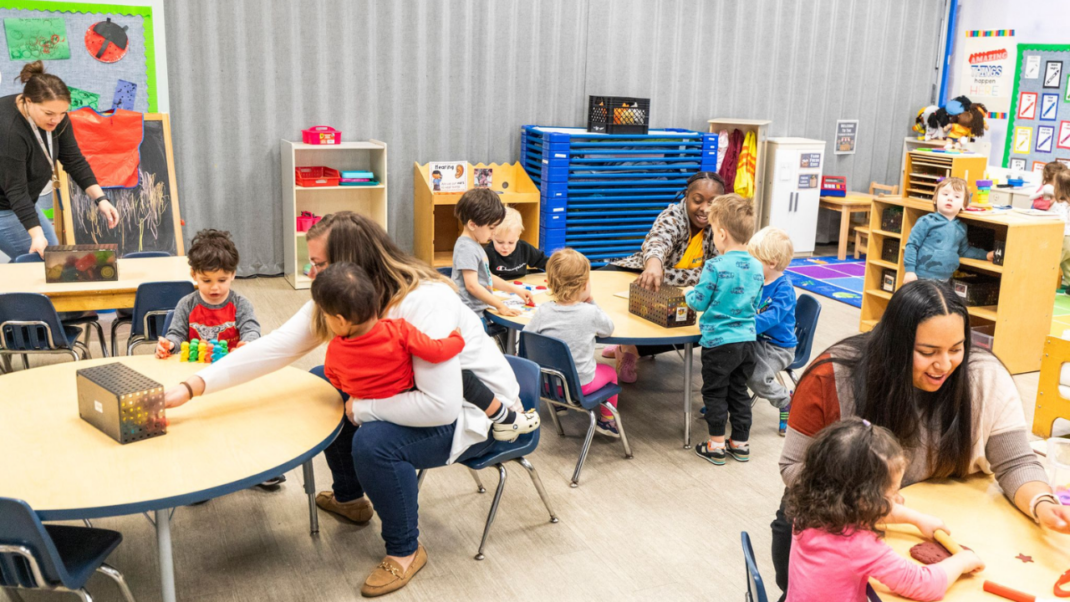
What a strong play-based classroom looks like
A quality play-based program creates rich learning environments, spaces where children can make choices, follow their curiosity, and build skills across every developmental domain. According to NAEYC, the role of play in early childhood curriculum is to support children’s growth across language, literacy, math, science, and social-emotional learning, all at once.
You will typically see things like:
- Literacy and language centers with books, puppets, and writing tools
- Math and science areas with manipulatives, nature materials, and open-ended problems to explore
- Dramatic play spaces that change to reflect current learning themes
- Art and creative materials that invite self-expression
- Outdoor play that extends learning beyond the classroom walls
The difference between a strong program and a weak one comes down to intentionality. Are teachers engaged in the play alongside children? Is the environment set up to invite specific skills? Are children challenged and supported at the same time? Those are the signs of a strong curriculum.
The teacher’s role
In a play-based classroom, teachers don’t just stand back, they join the journey. You’ll find them sitting on the floor with a small group, participating in a dramatic play kitchen game, and asking questions that stretch a child’s imagination. This skilled guidance is how our experienced teachers preserve consistent routines while keeping the learning environment safe, happy, and tailored to your child’s unique personality.
Frequently Asked Questions About Play-Based Curriculum
How do children learn to read and do math in a play-based classroom?
This is one of our favorite questions, because the answer is so much more interesting than most parents expect. Literacy is everywhere: in the songs they sing at circle time, the stories they act out in dramatic play, the labels on the shelves they read every single day. Math lives in the block tower they are trying to make taller than yesterday’s, in the snack they are helping divide equally among friends. By the time children leave a strong play-based program, they have been doing literacy and math for years. It just felt like play.
What developmental skills does play-based curriculum actually cover?
More than most people realize, and all at the same time. Language and literacy, math and logic, social-emotional skills, physical development, creative thinking: a well-designed play experience builds across all five areas at once. That block tower we mentioned? That is spatial reasoning, negotiation, fine motor skills, and creative problem-solving happening in a single ten-minute stretch. A worksheet can target one skill at a time. Play does not work that way, and that is exactly what makes it so powerful.
How does a play-based program track my child’s progress?
Not with tests, which is good news for everyone. Strong play-based teachers are observers first. They watch, they take notes, they photograph moments of learning, and they collect work samples that show how your child is growing over time. That information shapes what gets offered in the classroom next, and it gives you a real picture of your child as a learner, not just a score. When you visit a program, ask how they share this with families. The best ones will light up when you ask.
Ready to See It in Action?
Families in Georgia, Indiana, Iowa, Michigan and Nebraska choose The Learning Grove Academy because our play-based curriculum gives children the time and space to grow at the edges of what they can do, joyfully and purposefully, every single day. We would love to show you what that looks like in person. Schedule a tour today.
Related Posts
All Posts
Comparing Daycare Costs in Avon? What Full-Time Care Includes
How to Choose a Daycare in Avon, Indiana: What Paths to QUALITY Means